Choosing school library furniture is not the same as furnishing a classroom or a public library. On a single day the room may host a group of six-year-olds for story time, sixth-formers preparing a project and pupils who simply want a quiet place to read. The shelving, tables and other furniture have to serve them all, last for many years and fit a budget that rarely has much to spare.
This guide answers the questions we hear most often from school heads, school librarians and local authority staff: what size tables and chairs should be, how to choose shelving for school libraries, how to organise the zones and what to check before asking for quotes. At the end you will find a checklist to apply to your own case.
Why a school library needs different furniture
Today the school library is a working space for the whole school. According to the office of Portugal's School Libraries Network (RBE), the network includes 2,582 libraries, covering every state school cluster and non-clustered school, plus 31 private schools under association contracts. The RBE Strategic Framework 2021-2027 organises the work of these libraries around four pillars, and the first, «Places», brings together spaces, equipment and resources.
- libraries in the School Libraries Network
- 2,582
- private schools with association contracts in the network
- 31
- pillars of the RBE Strategic Framework 2021-2027
- 4
Three features set this space apart and change the way furniture should be chosen:
- Users of very different ages: in a school cluster, the same library may serve six-year-olds and seventeen-year-olds, with completely different statures and needs.
- Uses that change through the day: lessons, free reading, individual study, group work, visiting speakers.
- Heavy use: hundreds of pupils a week, chairs dragged around, tables pushed together and apart, books constantly coming and going.
Training for school librarians recognises this. An accredited course on the school library as a multimodal space, published by the RBE, devotes a session to furniture and equipment, covering technical standards for usability and ergonomics, and lists the European standard EN 1729-1 in its bibliography. That is where we begin.

School library furniture: what to analyse before choosing
The most common mistake is to start with the catalogue. Simply filling the room with furniture is not enough: first you need to understand who will use the space, how and when. Only then does it make sense to compare models, colours and prices.
- Observe: which classes and ages use the library, at what times, and which activities recur during the week.
- Measure: an up-to-date floor plan with windows, doors, columns, sockets, radiators and data points.
- Zone: decide where informal reading, individual study, group work, the teaching area and the computers will go.
- Choose: only then define table and chair sizes, types of shelving and how many pieces need castors.
- Install and follow up: installation, adjustments and fine-tuning after the first weeks of use.
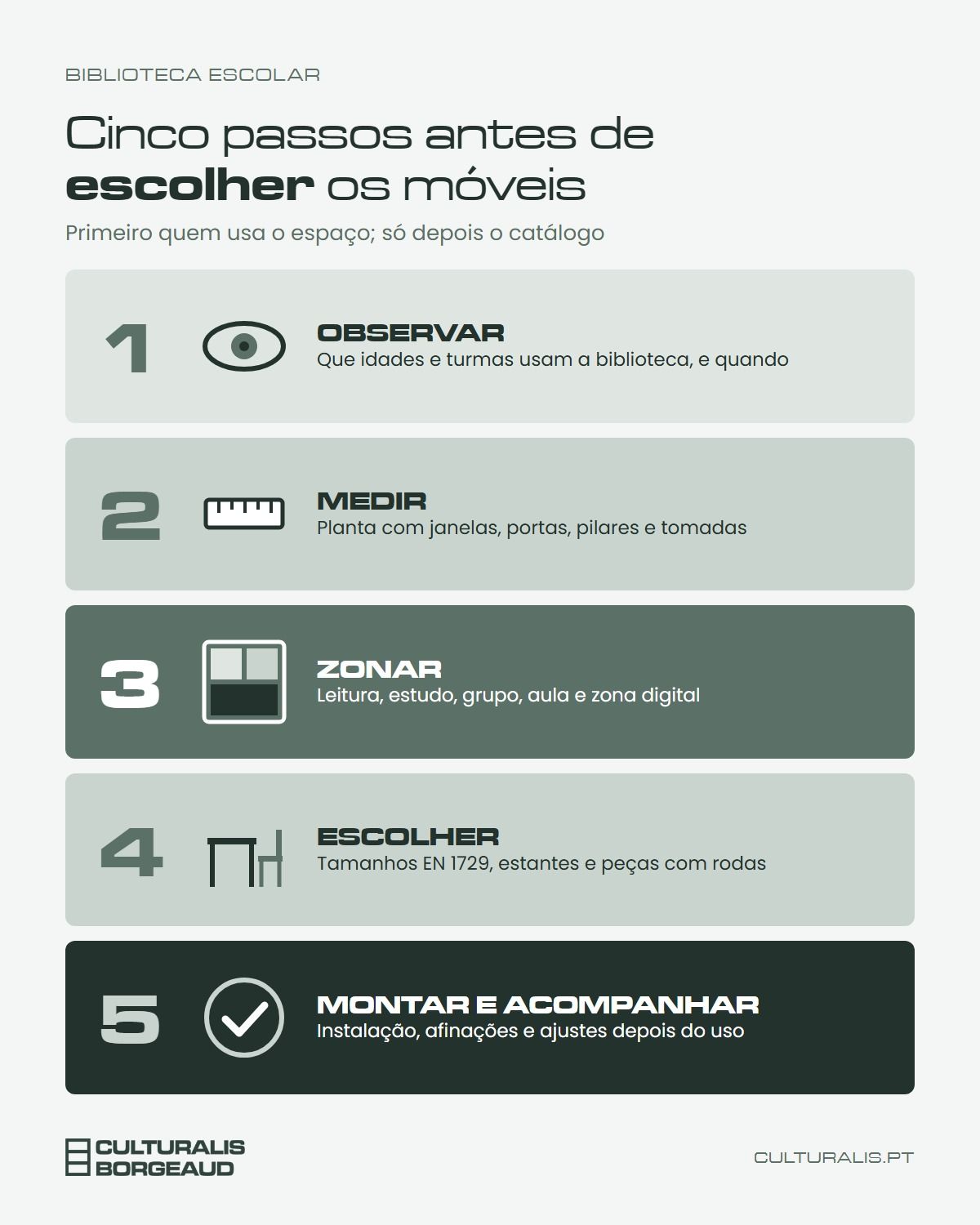
Read the infographic as text
The infographic shows five steps to take before choosing school library furniture. First, observe which ages and classes use the library and at what times. Second, measure the space, with a floor plan that includes windows, doors, columns and sockets. Third, divide the space into zones: reading, study, group work, lessons and a digital area. Fourth, choose table and chair sizes according to EN 1729, the types of shelving and the pieces that need castors. Fifth, install and follow up, with adjustments after the first weeks of use.
If the library already exists and is being refurbished, the analysis also covers what can be kept. Shelving in good condition can stay and be extended; tables that are too high for younger pupils usually cannot be fixed. Our article on how to equip the school library summarises the essential pieces; here we go into the detail of sizes and criteria.
Tables for school libraries: the right height for every pupil
There is a European standard for school tables and chairs: EN 1729. Part 1 sets the functional dimensions (table-top height, depth, width per person, legroom, seat height and depth) and Part 2 the safety requirements and test methods, including stability.
The standard defines eight size marks, from 0 to 7, each matching a range of stature and popliteal height (from the floor to the back of the knee), not age. According to the Italian laboratory CATAS, which takes part in the standardisation groups, the sizes run from a stature of 800–950 mm (size 0) to 1740–2070 mm (size 7). Each size has an identification colour, which makes it easy to check at a glance whether chair and table match.
The chart shows table and seat heights for the sizes most used in schools, according to the reference values published for the standard. The table top is 30 cm higher at size 6 than at size 1: an adult table in a primary area leaves children with their arms in the air and their feet dangling.
| Size | Colour | Stature (mm) | Indicative age | Seat (mm) | Table (mm) |
|---|---|---|---|---|---|
| 1 | Orange | 930–1150 | 3–4 years | 260 | 460 |
| 2 | Violet | 1080–1210 | 4–6 years | 310 | 530 |
| 3 | Yellow | 1190–1420 | 6–8 years | 350 | 590 |
| 4 | Red | 1330–1590 | 8–11 years | 380 | 640 |
| 5 | Green | 1460–1765 | 11–14 years | 430 | 710 |
| 6 | Blue | 1590–1880 | 14 years–adult | 460 | 760 |
The standard chooses the size by stature, not age; ages are only a guide.
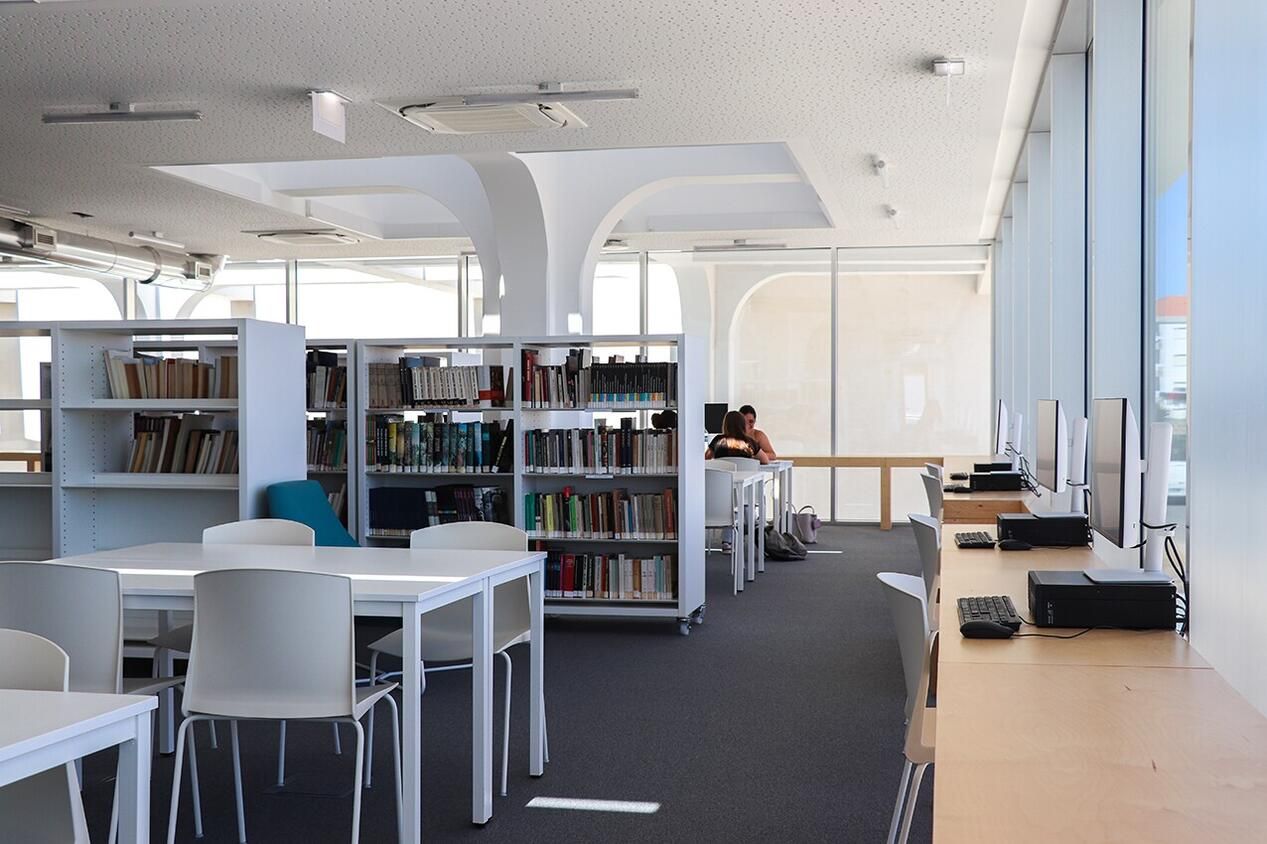
Because the size is chosen by stature, it is worth measuring a sample of pupils from each year group before ordering, rather than relying on age alone. In practice, a school cluster library rarely works with a single size. The sensible approach is two or three sizes, spread across zones: low tables next to the children's collection, mid-height tables for lower secondary pupils and standard-height tables for upper secondary pupils and adults.
Shapes and tops that help
- Rectangular tables for individual study and to push together into benches for lessons.
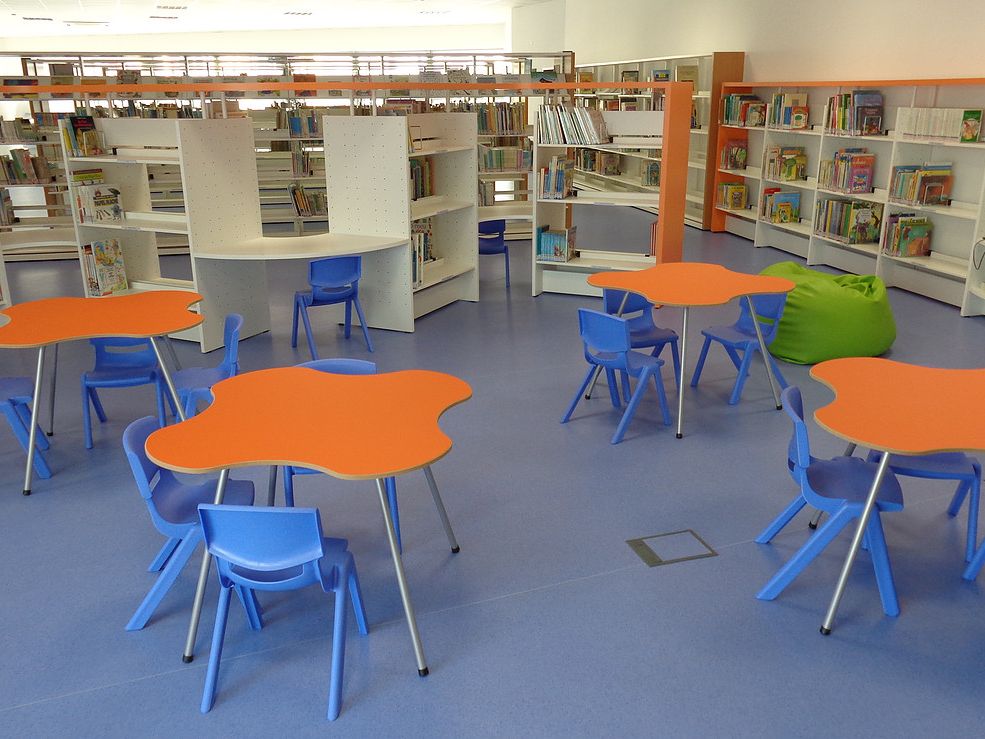
- Round or flower-shaped tables for group work and for younger children, with no sharp corners.
- Durable, easy-to-clean tops with protected edges, because they will be used and cleaned every day.
- Light, stackable chairs when the room has to change layout often.
Shelving for school libraries: height, access and mobility
Shelving for school libraries follows a simple rule: pupils should be able to reach the books meant for them on their own. A tall bookcase may be ideal for the upper secondary reference collection, but it is a barrier in the younger children's area, where they choose by what they see.
For younger children
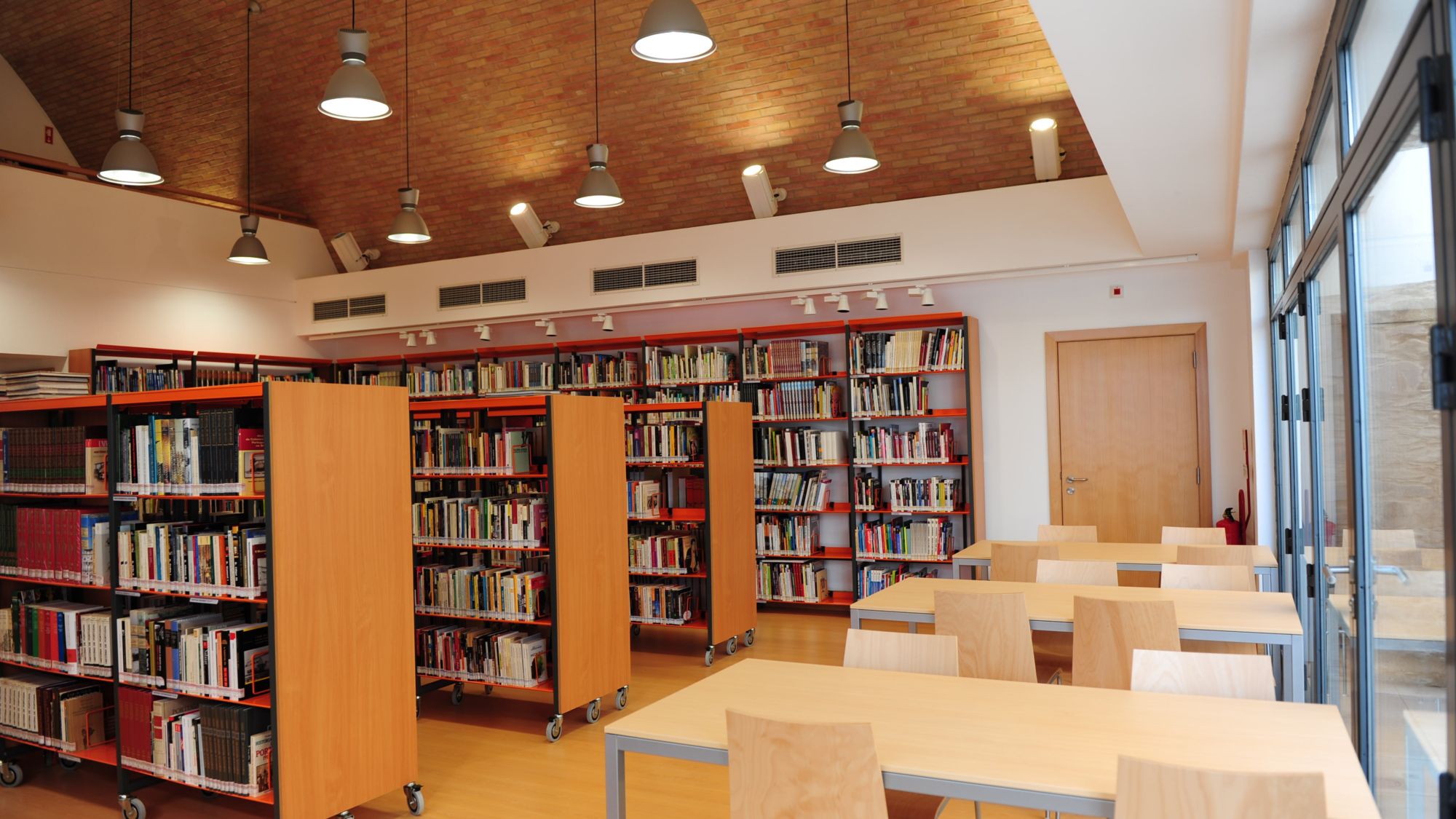
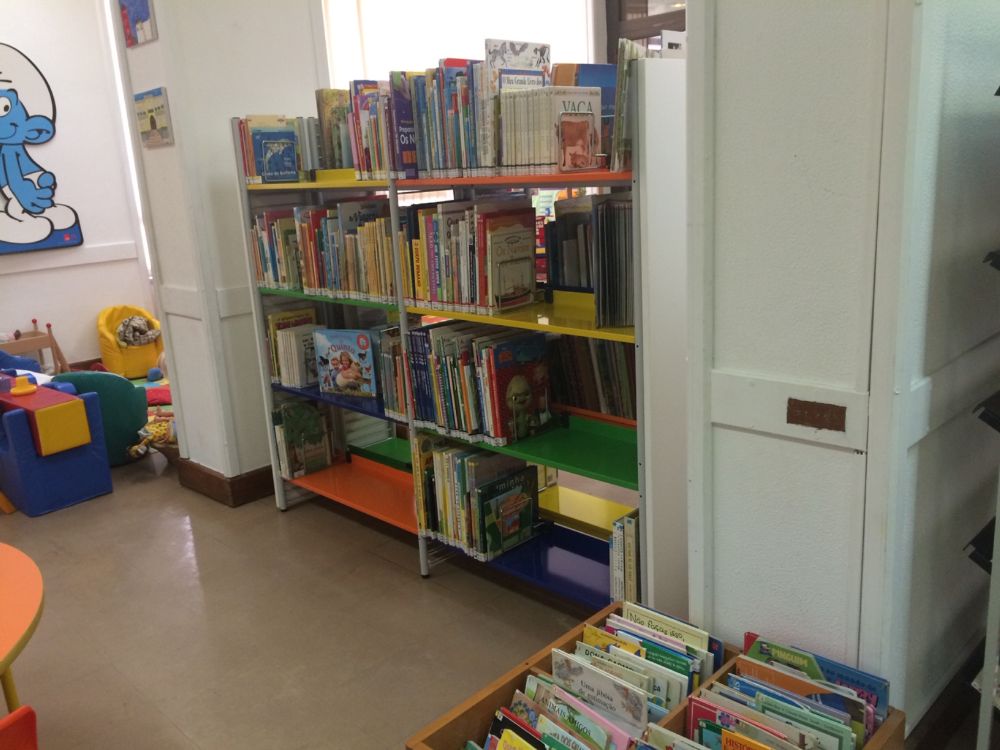
In the children's area, low shelving, browser boxes for picture books and face-out displays work best. Young children choose by the cover, not the spine. You can see this, for example, in the children's area of Barreiro Municipal Library, with colourful shelving and a picture-book box within children's reach.
For older pupils and the general collection
For older pupils, shelving can be taller, with adjustable shelves for different formats, clear signage on the end panels and room for face-out new titles. It is worth leaving some free space on each shelf so the collection can grow without everything having to be moved.
Mobile shelving
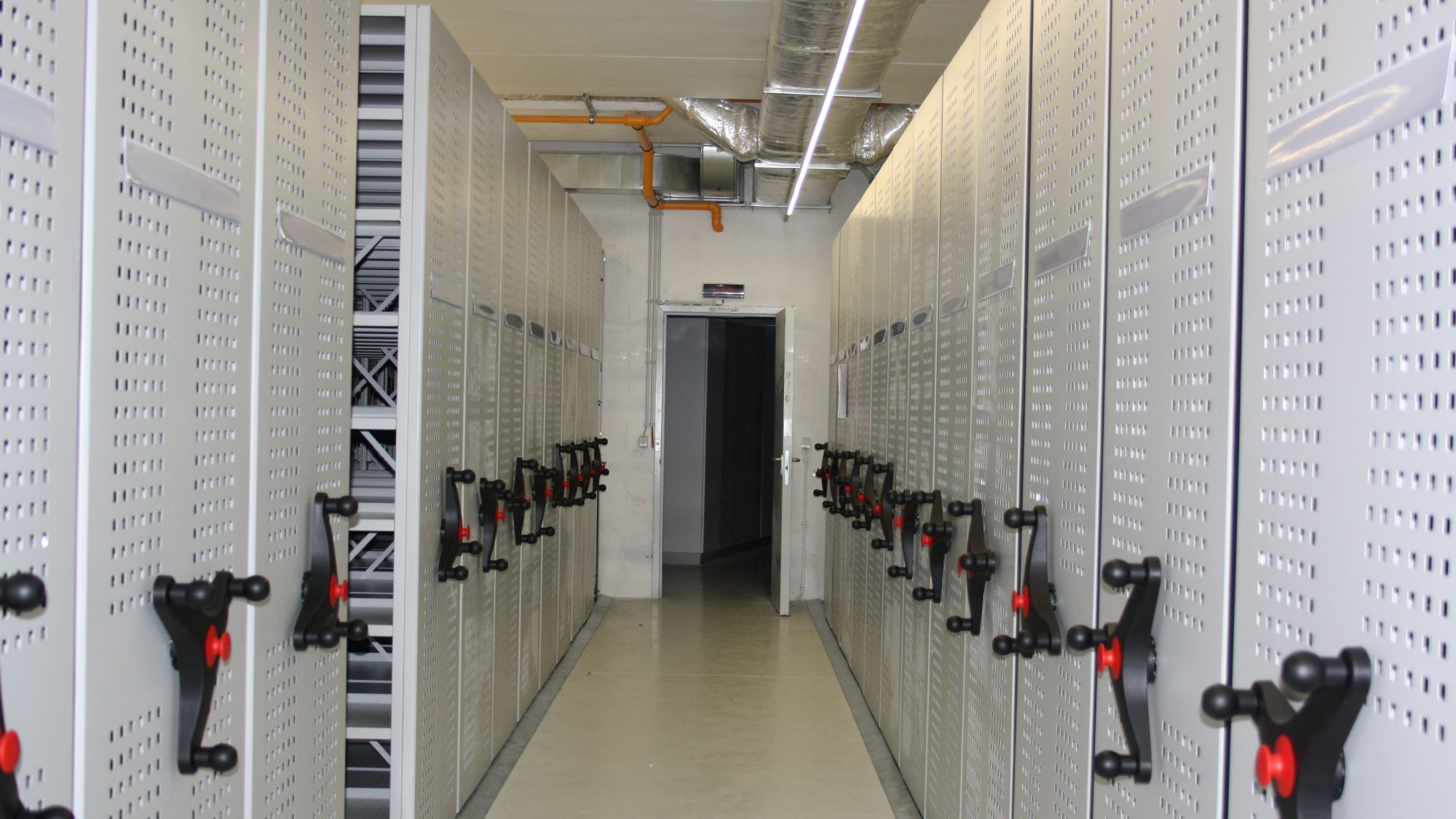
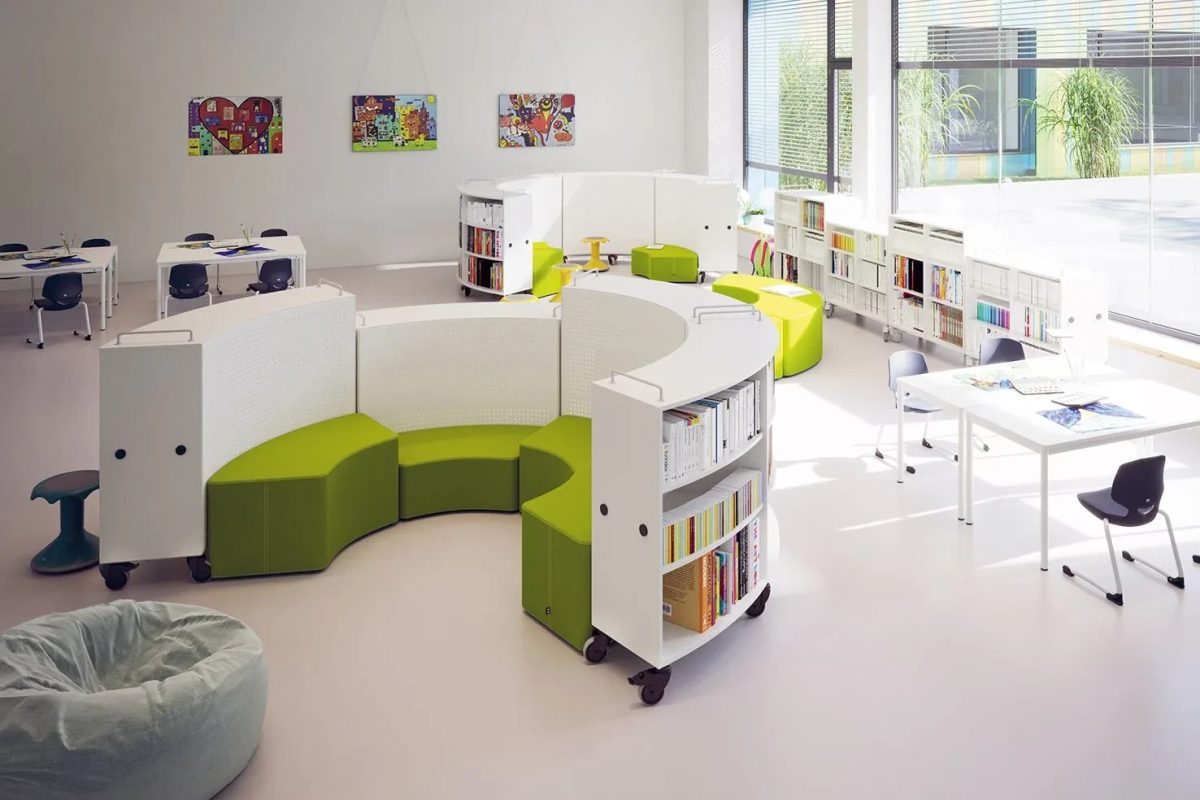
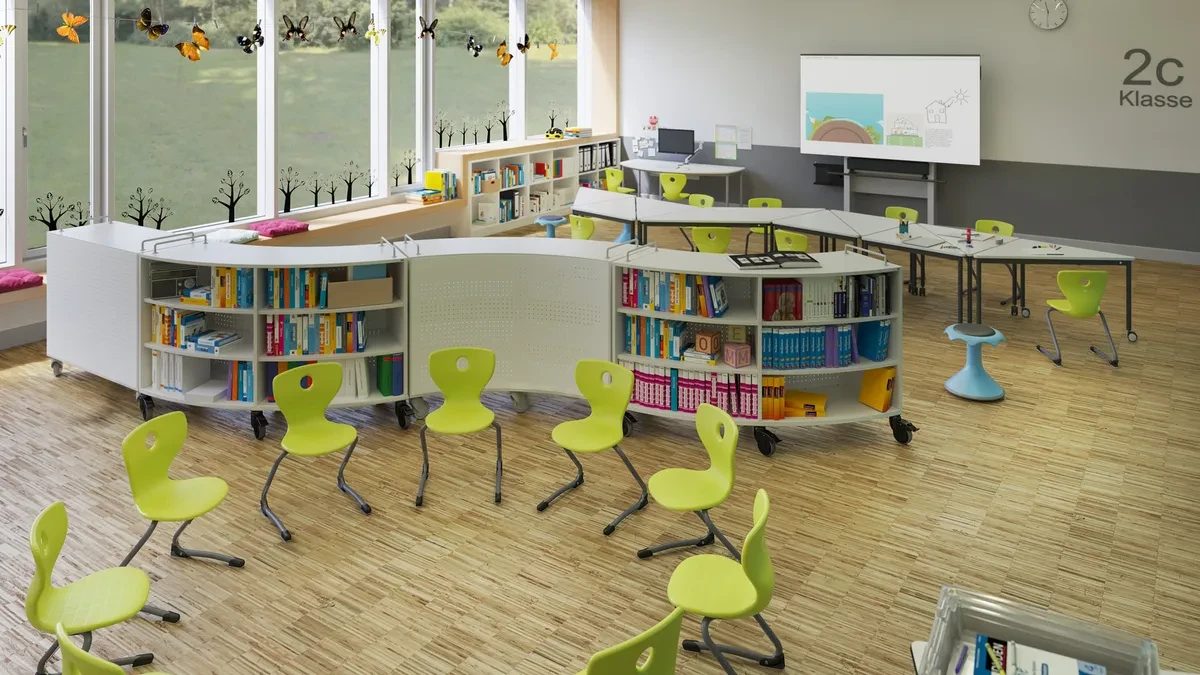
In a school library, some of the shelving should be on lockable castors. That way the same room can make space for a lesson, a presentation or a reading session in a few minutes and go back to normal afterwards. The curved mobile shelving by VS, the German maker of school and school library furniture with whom Culturalis is an official partner, was designed for exactly this.
Zones and furniture: a library that changes through the day
Organising the library into zones stops a group discussing a project from disturbing pupils who are studying, and keeps story time out of the computer area. Each zone needs its own furniture:
- Informal reading: low seating, poufs, rugs, low shelving and displays.
- Individual study: tables for one or two, direct light on the work surface, away from the entrance.
- Group work: round or combinable tables, light chairs, a board or screen nearby.
- Lessons and events: open floor gained by moving mobile shelving aside and stacking chairs.
- Digital area: tables with sockets and cable management, at the right height for screens.
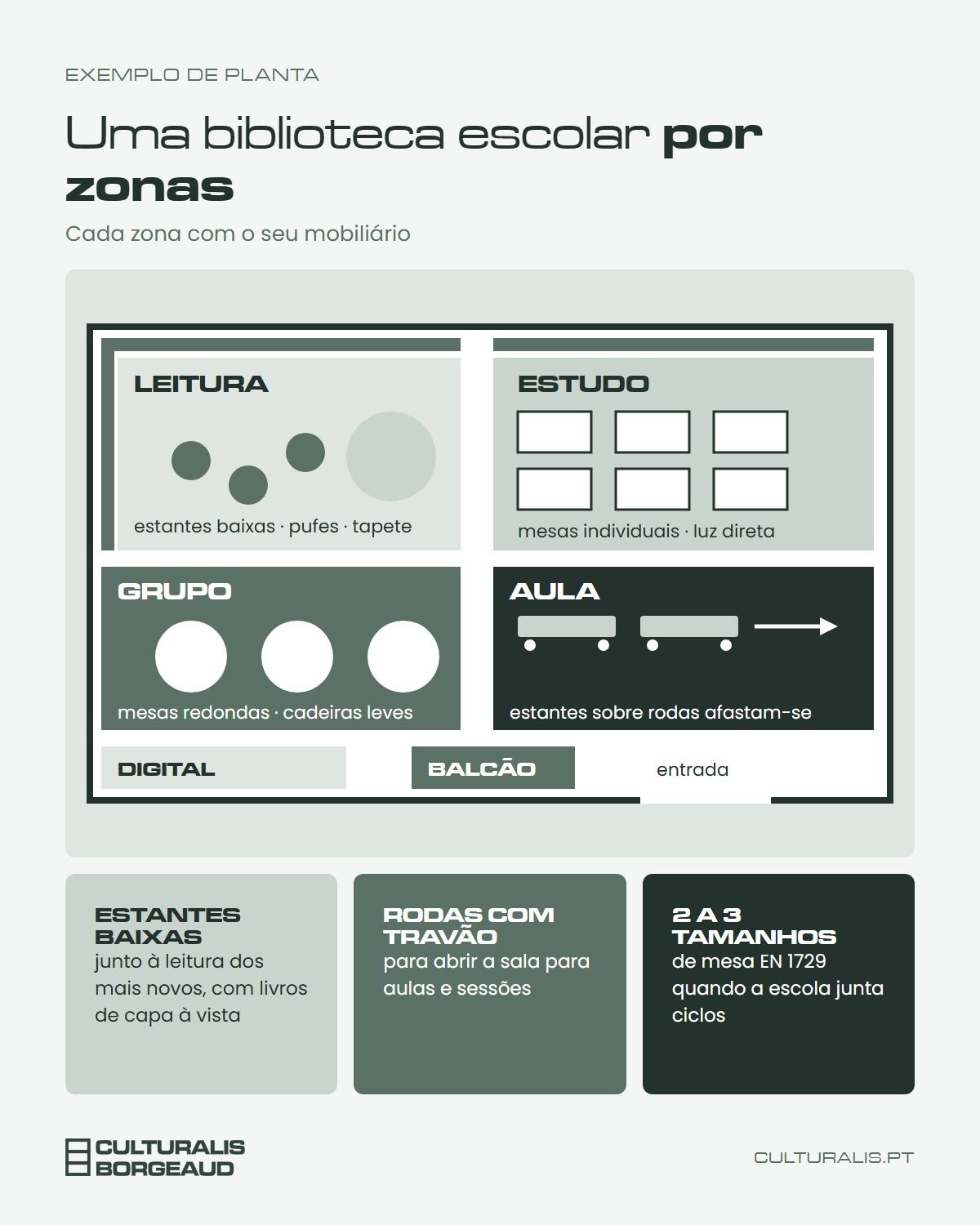
Read the infographic as text
The infographic shows an example floor plan of a school library organised into zones. The informal reading zone has low shelving, poufs and a rug. The study zone has individual tables with direct light. The group work zone has round tables and light chairs. In the teaching zone, mobile shelving moves aside to free up space. There is also a digital area and the desk by the entrance. Below, three ideas: low shelving with face-out books next to the younger children's reading area; lockable castors to open the room for lessons and events; and two to three EN 1729 table sizes when the school spans different age groups.
The diagram is just one way to organise a rectangular room; every school has its own floor plan, windows and supervision rules. That is why the space study comes before choosing furniture. You can see how these zones work in finished schemes on our projects page, and browse the available ranges in our catalogues.
Materials, safety and durability
In a school, furniture is put to the test every day. Part 2 of EN 1729 deals precisely with safety requirements and test methods, including the stability of chairs and tables. When comparing proposals, always ask for the standard and the size of each piece.
- Structure: stable shelving, fixed to the wall or joined together when tall, and lockable castors on mobile units.
- Surfaces: tops and shelves resistant to scratches and frequent cleaning.
- Edges and corners: rounded or protected edges, especially in the younger children's areas.
- Replacement: parts and accessories that can be replaced over the years without changing the whole unit.
Books need care too: protective covers, labels and other library supplies extend the life of the collection in a space as busy as a school's.
Checklist before asking for quotes
Use this list to see where your project stands. Tick what is already done; the result appears at the end.
Tool
Is your school library project ready?
Tick what has already been decided or done at your school.
0 of 10
A guidance list based on the functional and safety dimensions of EN 1729 and the good practice described in this article.
Next steps
In short, to choose the right school library furniture:
- Start with who uses the space, and only then turn to the catalogue.
- Choose tables and chairs by the EN 1729 size that suits pupils' stature, with two or three sizes if the school spans age groups.
- Put younger children's books within their reach, on low shelving and displays.
- Keep some shelving on castors so the library can change through the day.
- Insist on durable materials, proven safety and follow-up after installation.
Culturalis Borgeaud has designed and supplied library furniture since 1990, with more than 300 libraries furnished in Portugal, and follows each project from the first study to final installation with its own team. See our school library furniture solutions and the full range of library furniture, or contact us to request a study of your school's space.